When enough was truly enough.
Early Human Life
We know almost nothing about 98% of human existence, but what we do know suggests we were doing something right. For most of our time on Earth, humans lived within planetary boundaries. Our populations were small, our appetites and habits met our daily needs, and we learned how to coexist with our plant and animal relatives. We also learned to adjust to changing climatic conditions and weather. We lived in the African Savannah and among the glaciers. We did so together, comingled, learning, and growing.
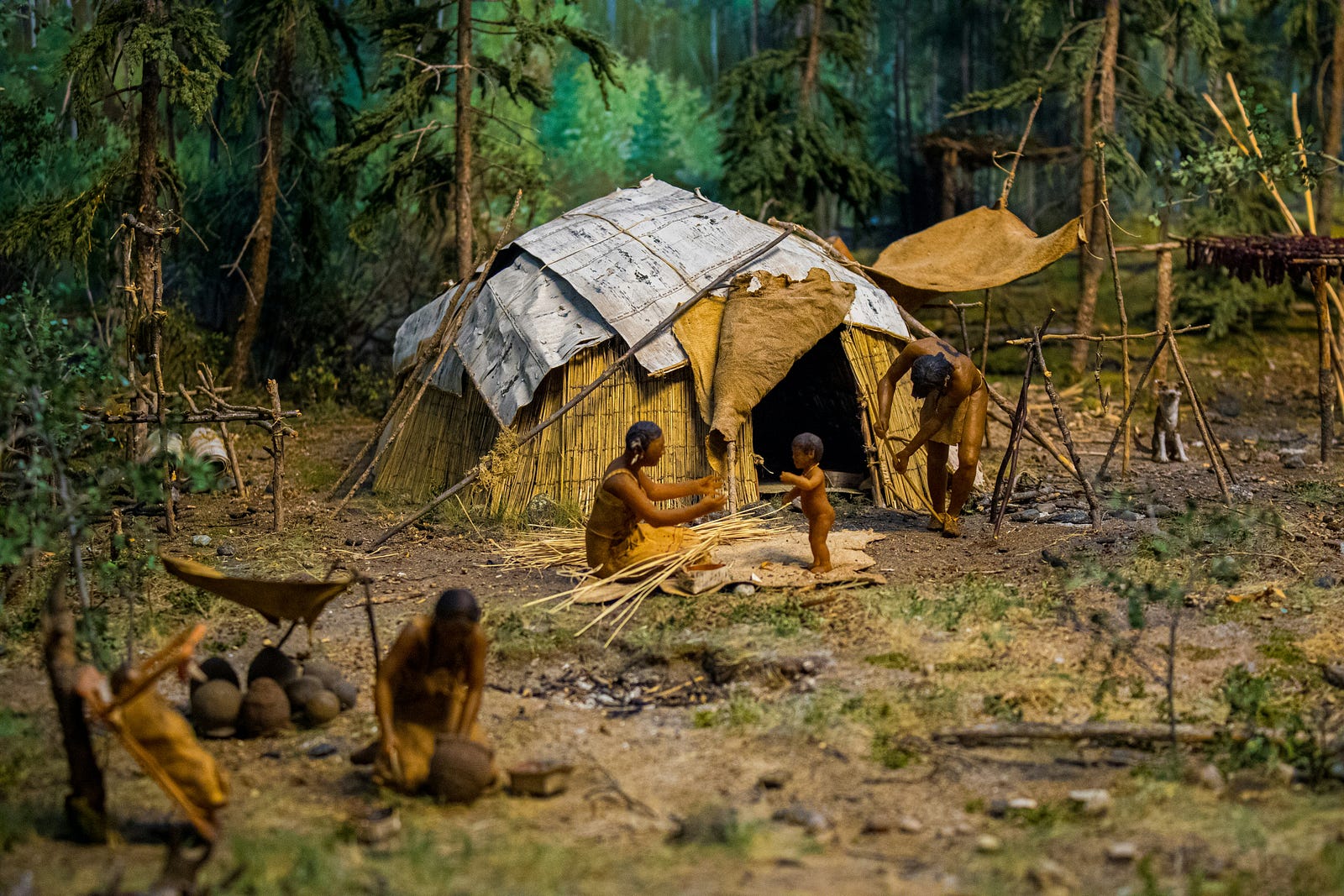
What emerged from the last ice age, 12,000 years ago, was a species characterized by adaptations made possible by social evolution and group selection. We lived in villages, celebrating births and grieving deaths. We adjusted to changing seasons and followed our world’s dynamic patterns. Nature was our parent, teaching us how to exist and coexist. As we learned, we met our needs more readily and enjoyed energetic and nutritional surplus. The combination of a warming planet and ecological prowess led to increased fitness for culture, communication, and cooperation.
Finding Enough
Post-Pleistocene humans spent their days collecting and planning, but also learning and experiencing. Our celebrations were festive, full of singing and dancing. We napped, had sex, and laughed perhaps more than we have since. We were musical and communicative. Ultimately social. Together we watched nature and learned from her how to feed each other, shelter our kin, and immerse ourselves in living.
With needs met and time liberated, leisure became the mother of language and culture. We looked to nature, rather than our individual selves, to help us understand who we were. How we lived mimicked what we observed in the animals and plants around us. We saw ourselves as one member of a larger web doing the same necessary business — growth, maturity, sex, babies, and inherited wisdom. We studied animals, watching their behaviors. We learned from plants, experimenting with taste and even medicine. Gazing into the night skies, we came to appreciate time passing as day and night, summer and winter, and life and death.
Culture expanded our neurological systems in unprecedented ways, maximizing our potential for experience. We integrated the joys and sorrows of humanity. We began to separate from other animals in this way, but in every other way, we were connecting. Solidified in the foundation of belonging to the Earth, and to life itself. The explosion of curiosity led us to communicate more and with increasing prowess. Language became commonplace. Our understanding of ourselves, each other, and our world was not individual; it was collective.
And where this understanding ran out, storytelling and even religion began to explain what was left. We had everything we needed. Not abundance, not scarcity — sufficiency. Enough.
Nature as Teacher
Ten thousand years ago, human culture was in harmony. We were balanced. With our advancing neurology, our well-established physiology, and our growing interactions, equilibrium felt natural. We had what we needed and learned how to maintain it. It makes sense that a cultural homeostasis would follow biological systems, at least on smaller scales. Our blood maintains a neutral pH to keep us alive. Our bodies are adapted to the temperature ranges inherent to planet Earth. Resource availability governs biomass, and competition regulates speciation. All life circulates within natural limitations.
As culture became the focal point for human evolution, we found the ultimate interspecies interaction in cooperation. Language, religion, and storytelling were integrated into a single foundational cultural element. Cooperating made life better. By borrowing from social insects like ants, ecosystem engineers like beavers, and family-oriented animals like geese, human culture became incredibly fit in the most Darwinian sense possible. We succeeded because we worked together. We found cultural homeostasis in group-level peace.
Within the village, harmony expressed itself as diversity. Nature fascinated us with her complexity and variation. Birds built homes for their families in myriad ways. Different plants had unique flavors. Every person brought skills and ideas to the group. Nature was diverse, and we embraced it as part of the harmony. We couldn’t have known how perfectly adapted for this system we were. Inside our cells, DNA and chromosomes sorted themselves out as we reproduced. Individual humans behaved slightly differently and flavored the villages with their skills and characteristics. Who we bred with, who we worked with, and how the village itself integrated into the surrounding world, including other villages, was available for selection in the same way. Balance meant diversity. Diversity meant survival. Survival meant persistence through time and immortality. Though we couldn’t have known it, we were spectacular.
Until They Didn’t
What more could a species want? Coming out of an ice age, at least in northern latitudes, was like stepping into a warm bath. Coupled with our increasing prowess in finding food, mating, language, and social structure, our capacity for togetherness expanded dramatically. The thing about diversity, though, is that even some maladaptive traits stick around.
Harmony, balance, comfort, and joy persisted for thousands of years. We became increasingly complex. Languages evolved. How and what we ate shifted to a mix of hunted, gathered, and cultivated foods. Who we had sex with likely reflected increasing parental care. Our kinship became more cooperative, and our disagreements more entangled. Humans are not immune to violence, and cultures likely include mechanisms to keep us in harmony. Dark triad personality traits existed, but we shamed misbehavior, shunned non-cooperative individuals, and may have even murdered the worst offenders. Villages protected themselves, valuing and nurturing harmony.
Hunting prowess wasn’t rewarded; it was ridiculed. No one was above another. Exchanges were gifts, and no one expected anything in return for favors or good deeds. Arrogance was met with a cold shoulder — ignored. Boasting or showing off were considered childish behaviors and provided entertainment instead of admiration. And if someone tried to possess anything or anyone as their own? They were humiliated. Continued and repeated offenses risked eviction from the adaptive group protections.
No one is denying that hominids have a dark side. We can be violent and murderous when we need to — modernity still permits violence in defense of the weak, and punishes it when wielded for aggression or vengeance. Competition helps when resources are scarce, but turns maladaptive once villages need to unite against a common threat. Part of the cultural explosion between 10,000 and 5,000 years ago was exactly this: prosocial mechanisms developed to maintain order at the group level. Groups that cooperated ate better, organized more equitably, and reproduced more successfully — fit villages beget fit villages. When dark triad personality types misbehaved, they were shunned or shamed into submission, even within egalitarian, non-hierarchical structures.
These cultural devices adapted for cultural homeostasis may have been the greatest human achievement. They contributed to the massive bloom of neurological evolution that led to iPhones, symphonies, and rockets to Mars. More importantly, this post-Pleistocene explosion nurtured our light side: the species most neurologically and culturally derived, choosing coexistence over domination. Instead of competition and hate, we were building cooperation and love. We loved each other and the world around us. We took parental care to the logical extreme. Mechanisms of love and shame provided balance to the homeostatic system of human connection. Those mechanisms worked.
Until they didn’t.
This is the third part of a series. Here are parts one and two. Or find all my writings about the 10,000-Year Problem on Substack.
Discover more from The 10,000 Year Problem
Subscribe to get the latest posts sent to your email.