The Mystery
“Our understanding of early human existence comes from a handful of bone fragments that would fit on this table”. This was the answer to a question I didn’t know I needed. Our tour guide, an archaeology PhD with the personality of Ryan Reynolds in Deadpool, verified what I’ve been thinking all along. That is, professional knowledge of what happened before recorded history is speculative and largely unknown. I suddenly needed to comprehend what we actually know about prehistory. It seemed important, given that the period just after the Pleistocene led to Modernity, ancient Greece, and the scientific revolution. What could be more fascinating?
Homo sapiens has existed for over 200,000 years, though exact timelines depend on which scientists you ask. If the historical record goes back at most 5,000 years to Mesopotamia, that means we know practically nothing about who we were for 98.5% of our existence. Why is this not the most important question of our time? What I would soon discover was that human nature itself didn’t change—our social structures did, and catastrophically.
The Catalyst
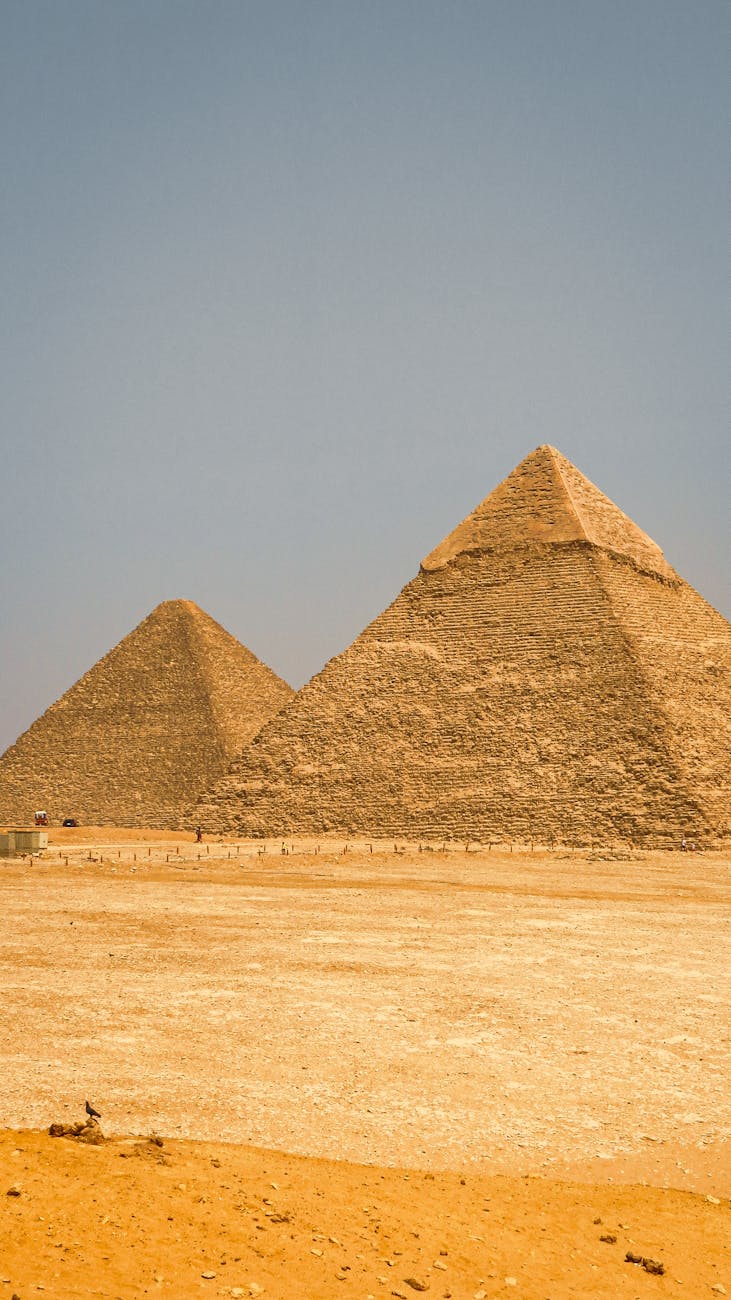
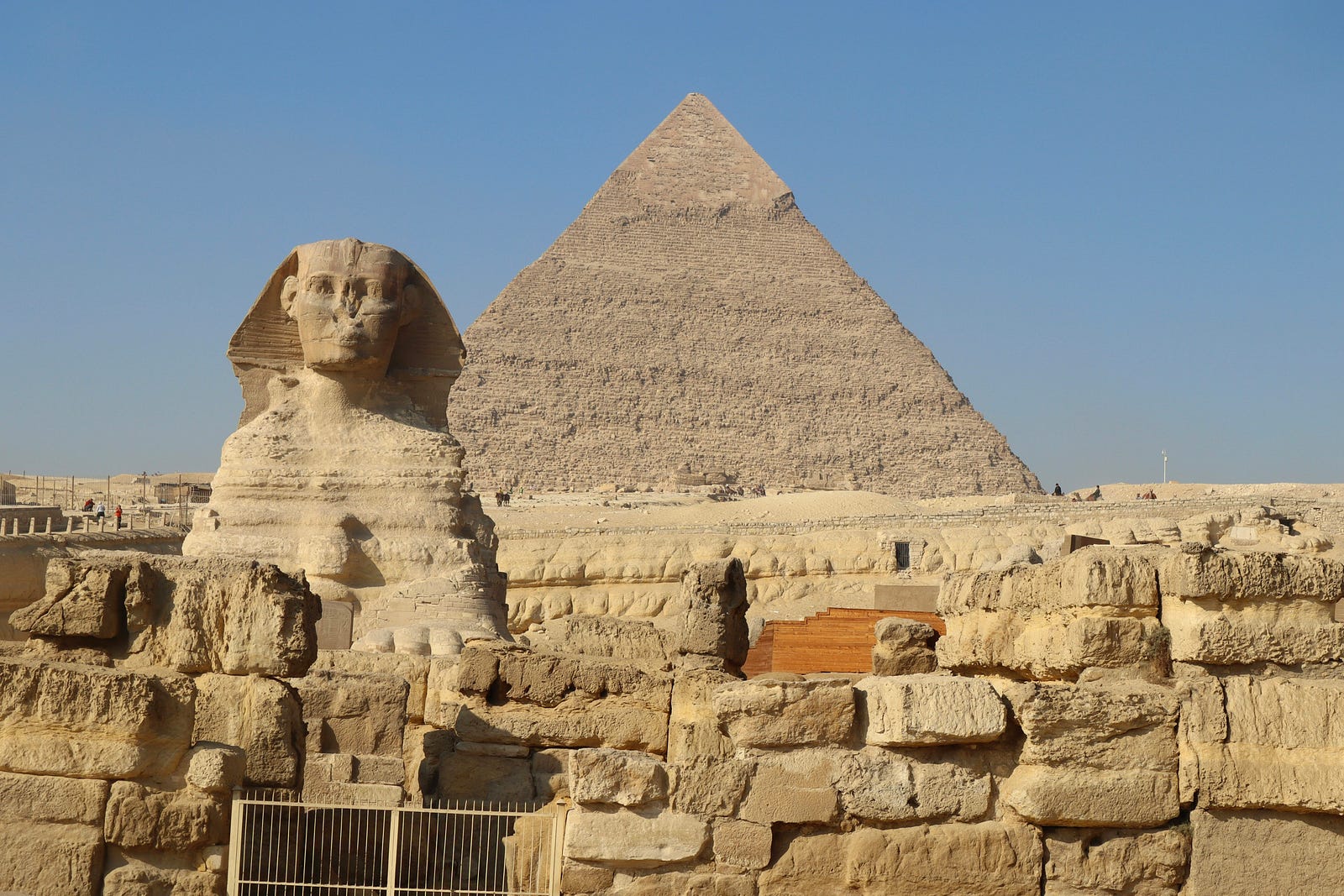
When visiting Egypt a short time later, seeing the great pyramids deepened my curiosity. And it wasn’t just the hugeness of the pyramids, but the fact they were built at all. Sure, the tour guides told us all about how we think they were made, but that’s a lot of human labor and some pretty sophisticated mathematics. Pharaohs had extreme power and wealth, and weren’t afraid to show it off. But what was the society like that built such ridiculous spectacles? Consider the dichotomy between powerful rulers wearing animal hats sitting on thrones of gold, while thousands labored day and night to appease their many gods. Pyramids aside, how did humans gain the ability to achieve such impossible feats of mysticism and power? What happened between 10 and 5 thousand years ago that made this possible?
The Reframe
When I was in high school in the 1980s, our ancestors were brutish savages. Lately, I’m reading about new research suggesting hominids were much more sophisticated. Natural selection wouldn’t favor competition, violence, and individualism as primary drivers. It makes more sense that positive interaction would be more beneficial. Sure, competition gets a lot more press because alpha male gorillas beating their chests is somehow synonymous with leadership, but that’s the exception to the rule, not the norm.
Natural selection favors genetic diversity. Diversity of genes, behaviors, and phenotypes – including social groups – means species can respond quickly to environmental change. If you’re playing the long game – and speciation most certainly should be – it makes way more sense that human societies would evolve to cooperate, empathize, and develop tools to reinforce group structures instead of a single alpha male-as-ruler scenario. The former facilitates niche expansion and speciation, whereas the latter ends with the last person standing.
Humans are obligated to social grouping. Being shunned and left alone means certain death. Thus, learning to get along has always been a critical part of being alive. Not getting along is maladaptive. Individual and societal phenotypes that focused on connectivity, cooperation, and empathy were certainly driving our successes in art and leisure, increases in neurological complexity, and mechanisms to minimize violence and power hierarchies.
Prehistoric humans enjoyed life. A mastery of ecology earned over a few hundred thousand years meant having food, surviving seasonal shifts, and knowing how to prepare. There was time for joy – something we could use more of now. Days were spent collecting and planning, but also learning and experiencing. Our celebrations were festive, full of singing and dancing. We napped, had sex, and laughed perhaps more than we ever have since. We had enough, a lack of distraction, and the ability to be in the moments of our ever-evolving lives.
Of course, violence and selfishness certainly existed. These are part of our nature, too. What I’m saying is that natural selection was, in effect, helping us choose routes that ensured our well-being. Moreover, top-heavy power dynamics, rugged individualism, and dark triad personality types, having narcissistic, Machiavellian, and psychopathic traits, were not selected for. Despite what’s been said about genes being selfish, life requires other life. Connection to the community does not result from selfish pursuits.
For all our flaws, we evolved toward community and cooperation. Toward enough. Yet somehow, we got Egypt.
The Collapse
Our emergence from the last ice age 10,000 years ago revealed unprecedented surplus and expansion. But surplus meant ownership, lootable wealth, and hoarding. These would prove tempting diversions from the peaceful harmony made possible by having enough. Having too much – seemingly a good thing – would be disastrous.
Ruthless power seekers saw an opportunity. Harmonious egalitarian societies meant sharing everything, including power. And while selfishness was easier to corral inside long houses, evolution would demand new social tools. That alpha male? He could easily destroy a few handfuls of peaceful folks. While harmony and community-mindedness are adaptive in small villages, they require coordinated effort to curtail darker human behaviors. As villages grew, alphas seized opportunities to loot and hoard wealth, creating hierarchies and conflict.
Natural selection expanded beyond individuals to influence tribes, villages, and even families. Cooperation and empathy, among the most unifying societal structures to evolve, would be tested against the strength of selfish exploitation. Hoarding plentiful resources created competition where it needn’t have been, inducing an artificial selection pressure. For the first time in 3.7 billion years, natural selection was being distorted by human behavior.
Hoarders of lootable wealth could more easily capture power because there were more roles to fill than just a single king. The arsenal of cabinet positions increased exponentially, along with an inversely related capacity to enforce. Instead of all community members sharing power and enforcement of social norms, this role was relegated to the military and police forces. Thirst for power, expanding niche availability, and reduced enforcement created a perfect storm that allowed dark triad personality types to take over.
Once in power, they redesigned the world. A pharaoh declares himself a god. Now questioning his authority isn’t politics, it’s blasphemy. A priest class emerges whose survival depends on maintaining the hierarchy. Women become property. Half the species loses agency overnight in evolutionary terms. Traits that used to benefit the whole now only serve the few. All of a sudden, the system has its own immune response.
These aren’t just political moves. They’re ecological feedback loops. Non-natural ones, but feedback loops nonetheless. The earlier homeostasis required mild enforcement to maintain harmony. This new version required violence, hierarchy, and mythology. Worse, it required obedience. But homeostasis is homeostasis. Once locked in, it resists disruption. A new equilibrium emerges: inequality.
Sumeria, Persia, Maya, and Egypt grew to critical thresholds and crashed. Dead and gone. Exploitative leadership works, until it doesn’t. Rome and other cities were overtaken by more powerful foreigners. Others, like the Maya, miscalculated increased resource use and exhausted stocks. The Taiping Rebellion nearly destroyed the Qing dynasty as lower castes rebelled against the most powerful. Though delayed, natural selection seemed to be correcting course.
To combat this, modernity found the ultimate positive feedback in fossil fuels. A once-in-a-species energy boost, burned through to prop up civilizations and keep extinction at bay. Now, vaccines, nuclear weapons, and a globalized economy all but ensure the persistence of even the most fascist regimes. The system continues to over-value itself as the greatest to have ever existed, blind to its own attribution error and weaponizing its survival.
We haven’t escaped the pattern; we’ve delayed it. And in doing so, made the eventual correction more catastrophic. We blew through 500 million years of stored sunlight to keep an evolutionary dead end alive. Enough.
The Call
Knowing what happened gets us partway there. The real question is, what are we going to do about it? We can’t solve this using traditional political and economic tools. We need to go back and understand what we lost.
Make no mistake: this is an evolutionary crisis. For 200,000 years, natural selection built us toward connection, cooperation, and the ability to thrive without hoarding. We abandoned that blueprint 10,000 years ago. The question now is whether we can remember it. And whether we still have time.
Only together can we know what those bones are trying to tell us.
This manifesto is a living document. I’m developing these ideas through writing, podcasting, and conversation. If you see gaps, complications, or pushback, please tell me. Let’s collaborate. This work improves through dialogue. chris.burcher@gmail.com
Discover more from The 10,000 Year Problem
Subscribe to get the latest posts sent to your email.